
Your Brain Is Lying About How Much You’ve Done
Why I built My Weekly Wins, a small, slightly annoying app for remembering your own progress.

Your brain is lying to you about how much you’ve done.
And no, it’s not because you’re lazy, or ungrateful. And no, you don’t need a better morning routine, a colour-coded planner, or some wellness girlie telling you to drink lemon water and talk positive affirmations in front of the mirror at 6am.
Your brain is just not a neutral record keeper.
It remembers the awkward meeting. The email you didn’t send. The thing you said weirdly. The task still sitting there, blinking at you from the to-do list like a tiny accusation.
But the five things you did finish? The decision you finally made? The conversation you handled better than you would have six months ago?
Gone.
Deleted from the system.
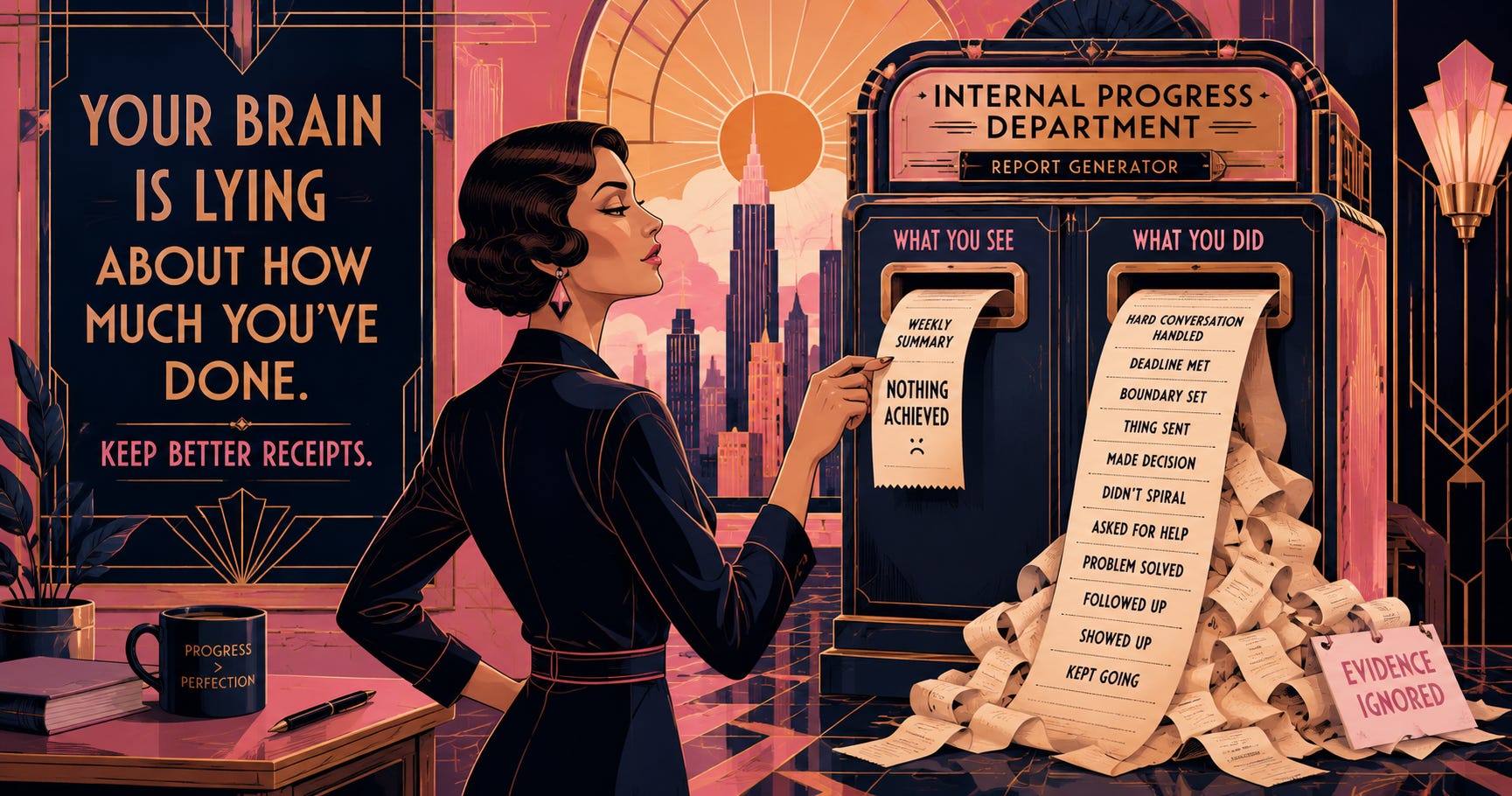
I built My Weekly Wins because I kept seeing this happen with smart people. People with good jobs, big brains, full calendars, too many tabs open, and a quiet sense that they were somehow still not doing enough.
They’d arrive at the end of the week and say some version of: ‘I don’t even know what I did this week’ or ‘I’m just not good enough’.
And then we’d unpack it.
They’d made a difficult decision. Had the conversation. Protected their time. Asked for what they needed. Moved something forward. Did the boring invisible work that keeps everything from collapsing.
Not nothing, then.
Just unrecorded.
And unrecorded progress has a way of disappearing.
This is the bit I find both fascinating and rude: your memory is not a fair witness. It does not sit there like a kind little archivist, carefully filing away evidence of your competence.
It is biased.
Selective.
Dramatic.
Often catastrophically bad at remembering the very things you most need to remember when you’re tired, doubting yourself, or wondering if you’re secretly a bit shit.
There’s research behind this, obviously, because I like my emotional damage peer-reviewed.
First: negativity bias.
Your brain tends to register setbacks, criticism, and mistakes more strongly than wins. Useful if you’re trying to avoid being eaten by a tiger. Less useful if you’re just trying to survive a weekday with Slack, deadlines, bills, ageing parents, weird hormones, capitalism, and one passive-aggressive email from someone called Brian.
In modern work, one difficult conversation can outweigh five things that went well. One tiny piece of criticism can erase a whole week of progress. One unfinished task can make you feel like the entire week was a write-off.
It’s a brain thing, unfortunately. Why can’t we be positive-bias instead?
Annoying, but workable.
Second: the progress principle.
Harvard researcher Teresa Amabile studied thousands of diary entries from workers across organisations and found that one of the biggest drivers of motivation and performance was not some grand cinematic breakthrough. It was perceived progress.
Small wins. Forward movement. The feeling of: something moved.
Not everything. Not the whole mountain. Just something.
And that matters, because most real progress is deeply unsexy. It looks like sending the follow-up. Asking the question. Making the appointment. Having THE awkward conversation. Not spiralling for three hours. Saying no without writing a legal defence. Choosing the less performative option. Taking the next step even though you still feel messy.
Tiny, yes. But not meaningless.
Third: self-efficacy.
Which is basically your belief that you can handle things. Not in an inspirational quote way. In an evidence-based, ‘I have done hard things before and therefore I may not actually die from this’ way.
Bandura’s work on self-efficacy shows that confidence is built largely through mastery experiences. Proof. Evidence. The record of having done something before.
But here’s the problem.
If you don’t record the evidence, your brain may not retrieve it when you need it. So when you hit a difficult stretch, you don’t just feel tired. You feel empty. As if you’ve never done anything. As if you have no proof. As if every hard thing is being faced by a brand new version of you with no history, no receipts, no previous wins.
That’s why I built My Weekly Wins.
Not as another productivity app. Ew, no.
We have enough dashboards. Enough streaks. Enough apps trying to turn basic human functioning into a competitive sport.
I didn’t want another place to optimise myself. I wanted a place to remember myself accurately.
My Weekly Wins is simple. It takes you 20 seconds. You set an email reminders, it sends you an email, you log what happened. The small thing. The boring thing. The brave thing. The thing you’d otherwise dismiss because it didn’t come with applause, a promotion, or someone saying, ‘Wow, you’re incredible, please take the rest of the week off.’
Then, at the end of the week, it reflects it back. Honestly. A little… annoyingly. Like a good friend who refuses to let you say, ‘I did nothing,’ when you absolutely did not do nothing.
Because sometimes what you need is not motivation.
Sometimes what you need is evidence.
A record.
A small file of receipts that says: you moved. You tried. You handled it. You kept going. You are not starting from zero every Monday.
I built this for coaching clients because I kept watching people live without an evidence file for their own competence.
And I built it for myself because, annoyingly, I am one of them.
My brain lies too.
So now I make it keep receipts.
Try it out here! Lemme know what you think.